

The Bookkeeper's Dessert Ledger: Pie in One Column, a Teacup in the Other
A retired Palm Beach club bookkeeper opens a ledger on her afternoons, and a pastry chef friend brings single-leaf tea. The label, the seller's caution, the research and the return terms, read line by line.

First, the people: Adele Fairbanks is a pen name. Inez, Gus, Walt, Dottie and the Thursday canasta table are composites, the way lanai columns have always been written.
Everything about the tea itself, its label, its price, its brewing directions, its caution and its return terms comes from the seller's own pages and the back of the bag, read in October 2026.
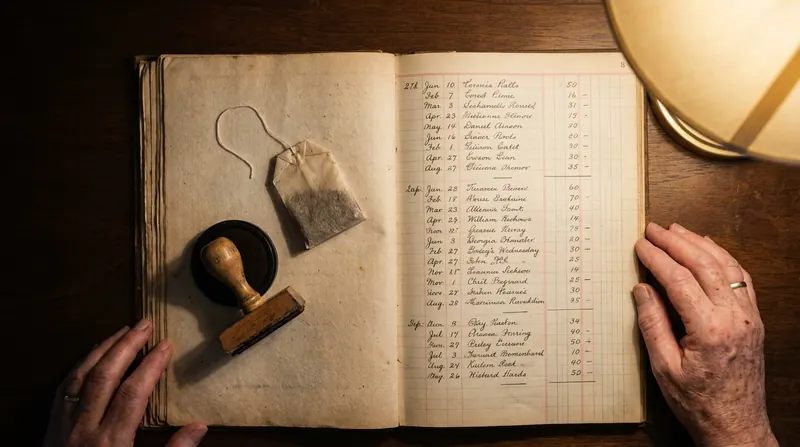
For thirty-one years I kept the books at a members' club on the island, and every lunch, every gin and tonic and every slice of coconut cake arrived on my desk as a signed chit.
A chit is a little slip of paper with a member number, a total and a signature. I read about four million of them, give or take, and I can still tell you which members underlined their names.
I retired in the spring of 2025, the week the club finally went to tablets. They gave me a cake shaped like a ledger, which I thought was very funny and also, as it turned out, a warning.
This column is about a different ledger. It's the red clothbound kind with two columns on every page, the kind I ordered by the case for three decades and never once opened for myself.
It's also about my friend Inez, who made the club's desserts for twenty-six years, and a green bag of single-leaf tea she set down on my wicker table one Tuesday in June.
If you've ever come home from a checkup with a direction instead of a verdict, you'll know most of this already. You just haven't seen anybody post it in two columns.
Thirty-One Years of Other People's Chits
The bookkeeping office was in the basement, under the main dining room, so all day long I could hear the chairs scraping and the silverware landing.
By two in the afternoon the chits came down the dumbwaiter in a wire basket, and I would sort them by member number with a rubber thimble on my right thumb.
You learn things about people from their chits. Who orders the same club sandwich for nineteen years, who tips in round numbers and who signs for the whole table and then never mentions it.
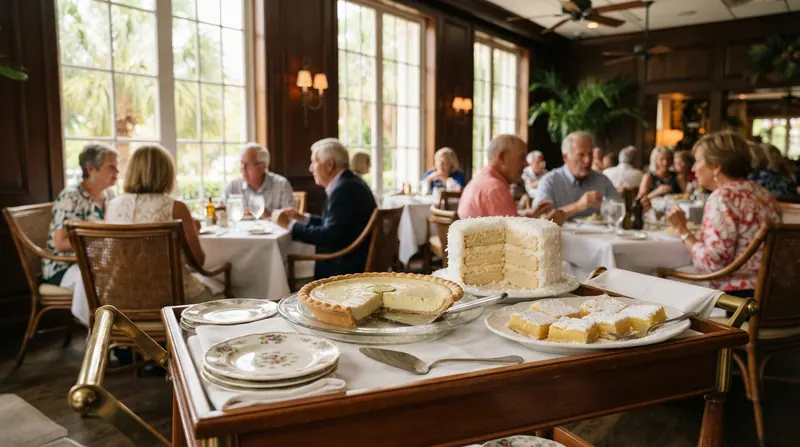
You also learn the shape of an afternoon. Lunch is salads and good intentions, and three o'clock is the pastry cart.
I used to joke that I could chart the island's resolve by the hour. At noon everybody was on a diet, and by three-fifteen the coconut cake had been signed for twice.
I didn't judge them, and I want that on the record. I signed for my own share, usually a sliver of key lime pie that Inez slid onto a saucer and sent down the dumbwaiter with the chits.
That sliver was my reward for reconciling the lunch receipts. For thirty-one years, three o'clock meant a column of numbers and a fork.
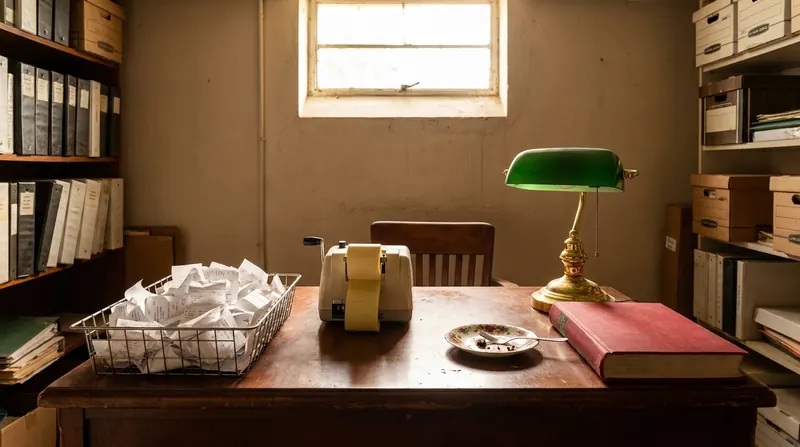
When I retired, I kept everything about the job except the job. I kept the thimble, the good pencils and the habit of checking the clock at three.
I also kept the pie. There was no dumbwaiter anymore, so I simply walked to the bakery on the corner and signed for it myself, in cash.
What Thirty-One Years of Chits Teach You
A bookkeeper isn't supposed to have favorite members, but everybody in the basement did. Mine was a retired harbor pilot named Mr.
Abernathy, who joined the club in 1979 and never once signed for dessert.
Every afternoon at three his chit came down the dumbwaiter with the same line on it. One unsweetened iced tea, lemon on the side, and a signature so neat you could have set type by it.
I asked him about it once, at the Christmas party, after a glass of punch had made me bold. He told me the iced tea wasn't about the tea at all.
"Three o'clock is a door," he said. "If you don't put something in the doorway, the pastry cart will."
He walked the croquet lawn after his iced tea, two slow laps, every afternoon until he was ninety-one. I posted his chits for twenty-two years and I never saw the pattern break.
I thought about Mr. Abernathy a great deal that first week with the red ledger.
I had read his doorway rule in ink, every afternoon, for two decades, and never once applied it to my own door.
That's the funny thing about reading other people's accounts for a living. You get very good at seeing the shape of an afternoon, as long as it isn't yours.
The members I worried about weren't the ones who signed for cake. They were the ones whose chits changed suddenly, from a sandwich to soup to nothing, because a ledger that goes quiet is a ledger asking for help.
I want to be fair to my younger self, too. For thirty-one years the pie was the reward at the end of a long reconciliation, and rewards are how bookkeepers survive month-end.
The trouble is that month-end stopped coming. I retired, the reconciliations ended, and the reward kept arriving at three o'clock every day without anything to reconcile.
The First Year Without a Basement
Retirement is wonderful, and anybody who tells you otherwise has never balanced a members' bar tab on New Year's Day. But it's also a ledger with no closing date.
The first months, Gus and I did all the things we'd postponed. We drove to Cedar Key, we repainted the lanai, and he rebuilt an outboard motor on the dining room table on a clean towel.
Our grandson Theo came down from Gainesville at Thanksgiving and asked why there were three bakery boxes in the refrigerator. I told him they were for company, and he pointed out, with the bluntness of a nineteen-year-old, that he was the company.
I laughed it off. Then I wrapped the last slice of coconut cake in foil and ate it standing at the counter at three o'clock the next afternoon, while Gus was at the marina.
Nobody saw, so it didn't go in any ledger. That's the thing about the hours nobody sees: they don't get posted, and the account runs on anyway.
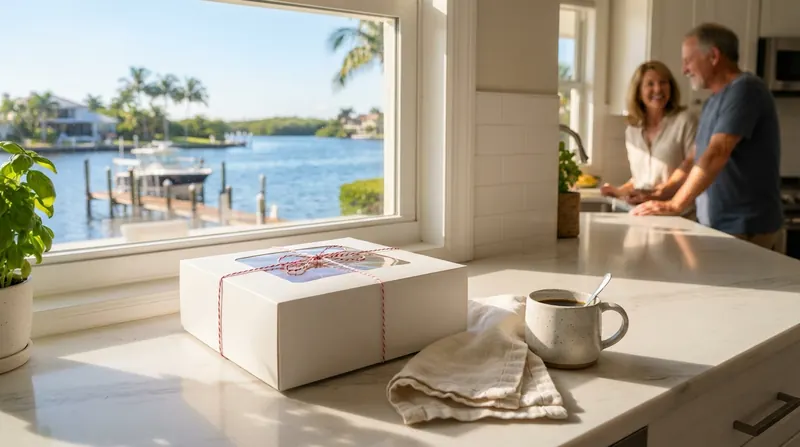
By the following spring, the bakery girl on the corner knew my order before I reached the counter. Key lime, one slice, a fork in the box, and a little bow on the string that she said was for me.
A bow on the string is a lovely thing, and I don't regret a single one. But it's also a chit, signed every afternoon, and I had stopped reading my own chits entirely.
The Three O'Clock Cart
Inez Calloway ran the pastry kitchen from 1997 until the club brought in a consultant with a laminated menu. She is seventy-two now, and she has the forearms of a woman who whipped meringue by hand for a quarter century.
She and I became friends the way people do in basements and kitchens. She sent down the pie, I sent up the corrected totals, and once a month we complained about the same assistant manager over iced tea.
After we both retired, the friendship moved upstairs to my lanai on Thursdays. That's where the canasta table meets, four women, two decks and one bowl of something sweet.
The bowl was the problem, though none of us called it that. Somebody always brought cookies, and Inez, out of professional pride, brought something better than cookies.
I'm sixty-six. My husband Gus spent forty years fixing boat engines at a marina in Riviera Beach, and he believes any problem can be solved by taking it apart on a clean towel.
Our kitchen faces the Intracoastal. In the afternoons the light comes off the water and lands on the counter, right where the bakery box usually sat.
I mention the light because that's where I first noticed it. The box was always there at three, and I had never once written it down.
A Direction, Not a Verdict
In June I went for my regular checkup. I go every six months because my clinician, a patient woman who reads labs the way I used to read chits, asked me to.
She turned the screen toward me. My morning reading had crept up two visits in a row, and the numbers after meals were following it up the stairs.
"Adele, this is a direction, not a verdict," she said. "Walk after supper, watch the afternoons, and come back in twelve weeks so we can see where it's going."
I said the thing every bookkeeper says when handed a bad statement. I asked her to print it.
She printed it. I folded it into thirds, put it in my handbag and drove home along the lake with the radio off.
I wasn't frightened, exactly. I was embarrassed, which for a woman in my profession is worse.
I had spent three decades catching other people's errors in the third decimal place. I had never once audited the woman who walked to the bakery every afternoon.
"Watch the afternoons" is a sentence that sounds simple and isn't. You can't watch something you've never written down.
That last line was my clinician's handwriting at the bottom of the printout. She underlined "actually," which I took personally, and which was correct.
Opening a Ledger on Myself
That evening I went to the hall closet and took down the last unopened red ledger from the case I'd carried home on my final day.
Gus watched me rule the first page with a steel ruler from his workbench. He asked if we were being audited, and I said yes, one of us was.
A double-column ledger is a simple machine. On the left you post debits, the things that take from the account, and on the right you post credits, the things that add to it.
I decided the account was my afternoons. Not my whole health, which belongs to my clinician, just the stretch from noon to suppertime that I had never once reconciled.
Debits were anything sweet that I chose, with the time. A slice of pie, a cookie from the canasta bowl and each packet of sugar in my coffee all counted as one entry.
Credits were anything that put the afternoon to better use. A walk of at least fifteen minutes, a glass of water before the bakery hour or a cup of something unsweetened all counted.
I didn't post the readings in the ledger. Those belong in the folder my clinician keeps, and I've learned that a number you check every hour starts checking you back.
The first full week, Monday to Sunday, I posted twenty-six debits and nine credits. I added them twice, the old way, because I didn't believe the first total.
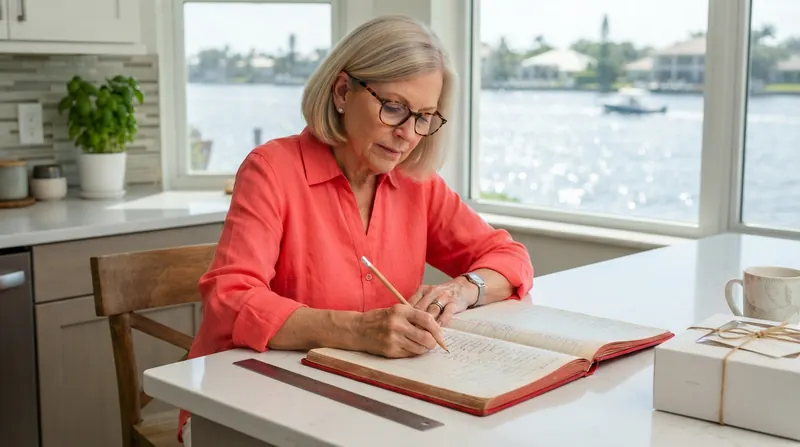
Twenty-six debits isn't a scandal. It's three sugars a day in coffee, a pie slice four afternoons out of seven and whatever came out of the canasta bowl.
But it's an account that had been running unaudited for thirty-one years. And the debits clustered, the way chits always do, between two-forty-five and three-thirty.
That's the hour the cart used to come down the dumbwaiter. My body had kept the club's schedule long after the club let me go.
You can't watch an afternoon you've never written down.
The second week I tried what every January resolution tries. I simply stopped, cold, and it lasted until Wednesday at three-ten.
On Wednesday I walked to the bakery in the heat and signed for two slices, one for the afternoon and one for the principle of the thing. The ledger recorded both, plus a third packet of sugar in the coffee I made to go with them.
That's what a ledger is good for. It doesn't scold, and it doesn't forgive either; it simply sits there in pencil while you decide what kind of bookkeeper you are.
I called Inez that night, mostly to confess. She laughed for a full minute, which is what pastry chefs do instead of sympathy.
"You're not fighting pie," she said. "You're fighting three o'clock, so give three o'clock something to do with its hands."
Inez Brings a Green Bag
The next Tuesday Inez came up my front steps at ten in the morning, which for a retired pastry chef is the middle of the night.
She was carrying a resealable green-and-kraft bag about the size of a paperback. She set it on the wicker table next to my ledger, squared it up with the corner of the page and sat down.
"Thirty tea bags," she said. "One leaf, nothing else in it, and read the back before you say anything, because I know you will anyway."
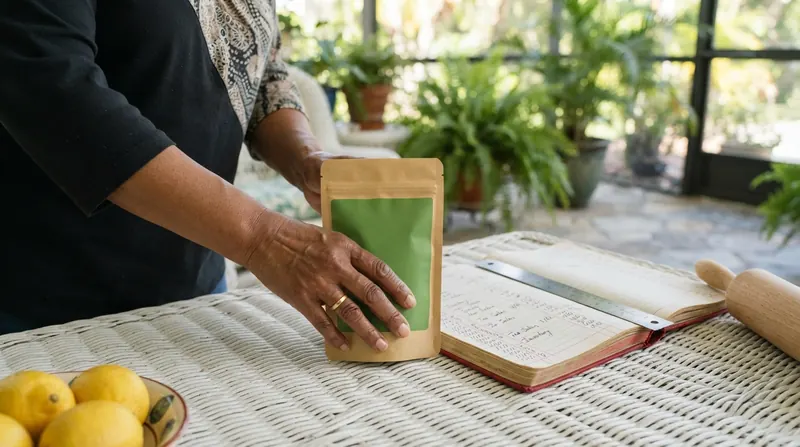
The bag said Palm Beach Herbals across the top, which made me smile. Then I turned it over, the way I'd turn over any invoice, and read the fine print first.
Ingredients: one line. "Gymnema Leaf, cut & sifted (Gymnema sylvestre)."
That's the whole list, and it's the shortest ingredient line I've read in years.
I have read cereal boxes with longer ingredient lists than some members' wills. One line felt almost rude, in the way honest people sometimes do.
"Gymnema," I said, sounding it out. "Inez, I have never heard of this in my life."
"You've heard of it," she said. "You just heard it in Hindi, in my kitchen, from a line cook named Ravi who wouldn't let me put sugar in his chai."
Did you read the back yet or are you still auditing the front?
7:42Read it twice. One line of ingredients, and I checked for a second page.
7:44There isn't one. Kettle at quarter to three tomorrow, and I'll call at three to make sure.
7:45You'll get my voicemail. I'll be busy with the timer.
7:46The Plant the Line Cooks Called Gurmar
Here's the story Inez told me on the lanai that morning, and it's the story that made me pay attention before any study did.
In 2004 the club hired a line cook from Gujarat, a quiet man with a thermos who kept a little tin of dried green leaves on the shelf above the fryers.
One slow afternoon, he handed Inez a leaf and told her to chew it for a minute. Then he gave her a spoonful of her own buttercream.
"It tasted like wet sand," she told me, still offended twenty-two years later. "My best buttercream, and it tasted like I'd licked a beach."
Ravi told her the plant's old name was gurmar. In Sanskrit and Hindi it is usually translated as "destroyer of sugar," because chewing the leaf dulls the taste of sweetness for a while. [1]
The effect wears off, Inez said, in about the time it takes to wash a sheet pan. But a pastry chef doesn't forget the afternoon her buttercream tasted like a beach.
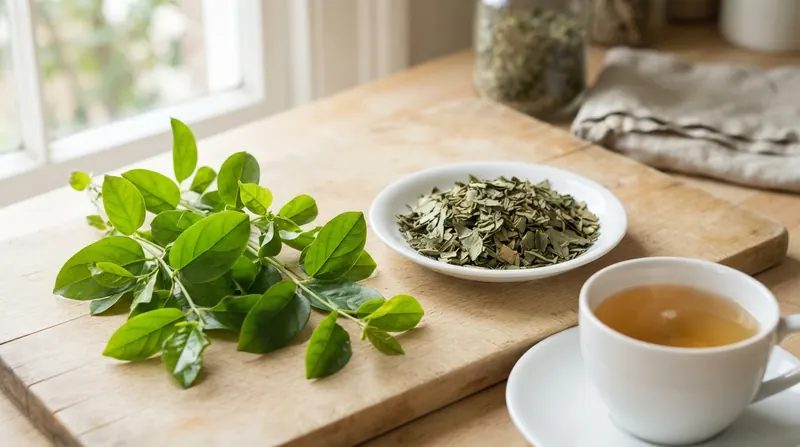
I asked the obvious bookkeeper's question. Does the tea do the same thing to buttercream?
"Sometimes I think so, a little, if I brew it strong," Inez said. "Some days I think I'm imagining it, because I'm a pastry chef, Adele, not a scientist."
That's the most honest sentence anybody said to me all summer, and I've kept it at the top of this column's notes ever since.
Then she said the thing that actually mattered. "I'm not bringing it because of the sand; I'm bringing it because it gives three o'clock a kettle."
I Phoned the Number on the Back
Before I put a single bag in a cup, I did what I did for thirty-one years whenever a new vendor sent an invoice. I checked that the vendor existed.
The back of the bag says "Distributed by" a company in Port Orange, Florida, with a street ZIP code, a phone number and an email address. The seller's contact page lists the same phone, (386) 274-8520, and a street address, 1955 Taylor Rd, Port Orange, FL 32128.
I'll be honest about one thing that tickled me. The brand says Palm Beach, but the bags are packed in Port Orange, which is about three hours up I-95 near Daytona.
That didn't trouble me. Half the "Palm Beach" businesses I paid over the years were headquartered in Boca, and one was in a strip mall in Jupiter.
I called on a Wednesday morning. A woman answered on the fourth ring, said the company's name, and told me the tea bags were packed there and shipped from there.
I asked whether the leaf was organic. She said the bag doesn't claim that, and she wasn't going to claim it on the phone either, which I respected more than any seal.
A phone that a person answers is the first credit I post for any company. It doesn't make a tea good, but it makes a company accountable, and those are different columns.
I posted it in the ledger that afternoon, on the credit side, in ink. "Port Orange: answered, fourth ring, did not oversell."
The Label, Line by Line
Here is the back of the bag the way I read it at my kitchen counter, with my steel ruler under each line so I wouldn't skip one.
Pure Herbal Tea Series: the seller's phrase for teas made from a single plant. "Pure and simple tea, one ingredient at a time," the back says.
Ingredients: Gymnema Leaf, cut & sifted (Gymnema sylvestre). One plant, chopped and sieved to tea-bag size, and nothing else listed.
30 herbal tea bags, net weight 1.59 oz (45 g): by my arithmetic that's about one and a half grams of leaf per bag. The bag doesn't print a per-bag figure, so that's my division, not theirs.
Caffeine-Free, Sugar-Free, No Preservatives, No Artificial Flavors, No Fillers. Those are printed on the front and back panels as the seller's own statements.
Manufactured in the USA from Globally Sourced Ingredients. In plain words, the leaf grows elsewhere and the packing happens here.
Flavor profile: "a mild, slightly bitter flavor with earthy, herbaceous notes and a hint of sweetness," the back says. Its aroma is described as fresh and green.
Directions: pour 8 oz of fresh, boiled water over a tea bag and steep for 5 to 15 minutes, depending on the strength you want. Use two bags for a stronger cup, and it can be poured over ice.
The FDA line. The bag carries the standard statement that its claims have not been evaluated by the Food and Drug Administration, in a small black box near the barcode.
The caution panel. The back asks you to seek the advice of a healthcare provider before using this or any other herbal product, "especially if you are pregnant, breastfeeding, or have any health conditions."
It adds one more sentence I'd like every herbal label in America to print, a plain reminder that some herbal products can interact with things you already take. I've copied that one into my ledger's inside cover.
The Seller's Own Caution, Printed Plainly
Now I want to show you the sentence that made me trust this company more than any seal could.
On the product page, right under the description, the seller writes about gymnema: "Because it can influence blood sugar," people who already manage their numbers with a clinician, or who take something to lower them, "should consult a healthcare professional before using gymnema."
I've shortened the middle of that sentence for this page. The full wording, word for word, is printed in the ingredient guide linked at the foot of this column.
Think about what that sentence costs a seller. It tells a portion of their likeliest customers to stop and ask somebody first.
In thirty-one years of reading vendor contracts, I learned that the clause a company didn't have to include tells you more than all the clauses it did.
The clause a company didn't have to write is the one that tells you who they are.
So I did what the clause said. I took the bag to my clinician's office, set it on the counter and asked the nurse at the window to pass it along with my question.
The answer came back the next day by phone. It was fine to try a cup in the afternoon as part of the walking plan, and it was even better to keep my ledger and bring it to the twelve-week visit.
Her office also told me to mention the tea at every appointment from then on. That's not because it's dangerous; it's because a clinician can't reconcile an account she can't see.
If you take anything at all for your numbers, please make that phone call before the first cup, not after. The seller asks you to, the label asks you to and so do I.
What the Research File Says, Sized Honestly
I went to the library because that's what you do when a vendor's product is new to you. The reference librarian found me one paper worth printing, and I read it twice.
It's a 2021 systematic review and meta-analysis. The authors gathered ten clinical studies with 419 participants in all, which is a careful way of saying several small studies were pooled into one bigger look.
Here's how I'd post that result in a ledger. Across those studies, gymnema supplementation was associated with lower fasting readings, lower after-meal readings and lower long-term average markers. [2]
Then, in the next column, I'd post the fine print. The results were compared with each person's own starting values rather than with a placebo group, and they varied widely from one study to the next.
And in the third column, the one most columns leave out, I'd post this. None of those studies tested this bag, steeped in a mug, at this strength, in a woman on a lanai.
The studies tested gymnema as a supplement in various forms. A tea bag of cut leaf in boiled water is the oldest way people have taken the plant, and it is not the same thing as a measured dose in a trial.
So I can't tell you, and nobody honest can, how much of anything ends up in a cup steeped for eight minutes. The bag doesn't print a milligram figure for gymnemic acids, and I won't invent one.
Statisticians call that variation heterogeneity, which is a polite word for studies that differ in dose, form, length and the people enrolled. Comparing the same people at the start and at the end is also weaker evidence than a trial with a placebo group, and I'd be a poor bookkeeper not to say so.
Why print a study at all, then? Because the honest reason gymnema keeps showing up on store shelves is that its research file is bigger than most plants' files, even if it's made of small studies.
And because the alternative is a page that prints only the headline. I spent three decades refusing to sign off on totals I couldn't trace, and I'm not starting now.
The way I posted it in the end, in pencil: an old plant, a real research file, mostly small studies measured against baseline, not this bag. The cup gets judged on what it does to my three o'clock, and my numbers get judged by my clinician.
Reading a Research File Like a Year-End Audit
At the club, the year-end audit came every February, and the outside accountants always asked the same three questions. How big is the sample, what are you comparing against, and who chose the numbers?
I asked those three questions of the gymnema paper, and I'd suggest you ask them of any study a tea box or a website puts in front of you.
How big? ten studies and 419 people, pooled. That's larger than any one of the studies alone, but it's a few hundred people spread across trials run years apart.
Compared against what? against the same people's own starting values. That tells you the numbers moved during the studies, but it can't fully separate the plant from everything else that changed while people were enrolled.
Who chose the numbers? the authors chose which studies to include and how to pool them, which is normal. They also reported how much the studies disagreed, and in this file the disagreement was large.
None of that makes the file worthless. It makes it a file, which is what research is supposed to be: a set of entries you read with a ruler under each line.
My clinician, when I showed her the printout, said almost exactly what the outside accountants used to say in February. "Interesting, and not enough to change the plan."
The plan stayed the plan. Walk after supper, watch the afternoons and come back in twelve weeks, with a cup at a quarter to three if I liked it.
How the Leaf Is Described Working on the Tongue
The part of the story I can describe with some confidence is the tongue part, because it's the oldest part and the one Inez tasted with a spoonful of buttercream.
Reviews of the plant describe compounds in the leaf called gymnemic acids. The traditional explanation is that they settle onto the sweet-taste receptors of the tongue for a while, so sweet things taste flatter until they wash off. [1]
That's an effect on the taste of sugar, and only for a while. It isn't a claim about what happens to sugar after you swallow it, and I'm not going to dress it up as one.
What I noticed in my own cup was milder than Inez's beach. A strong cup, two bags for twelve minutes, made the first bite of pie taste a little less like an emergency.
A weak cup, one bag for five minutes, tasted like a pleasant green tea with a dry finish and did nothing at all to the pie. Both observations went in the ledger, and neither is a study.
Brewing It the Bookkeeper's Way
I'm going to give you my method, not because it's better than the label's, but because a method is how bookkeepers stop arguing with themselves.
At two-forty-five, the old dumbwaiter hour, I fill the kettle. I don't decide whether I want a cup, because deciding is what three o'clock is good at.
I pour eight ounces of water just off the boil over one bag, sometimes two, and set the kitchen timer for eight minutes. The label allows five to fifteen, so eight is my midpoint, rounded the way I'd round a petty-cash count.
While it steeps, I post the cup in the credit column and look at the debit column honestly. Most days that look is enough to make the bakery feel very far away.
I don't sweeten it. The label suggests honey or stevia if you want, but the "hint of sweetness" it promises is real enough for me after the first week.
On the hottest afternoons, I brew it double strength and pour it over ice with a lemon wedge. Gus calls it "the lawn," and he drinks half of mine when he thinks I'm not looking.

The taste deserves a fair paragraph, because Inez and I argued about it. It's mild and green, a little bitter at the back of the tongue, with a dry, almost tannic finish like a strong black tea without the caffeine.
Steeped five minutes, it's gentle. Steeped fifteen, it's assertive, and the bitterness is the point, at least according to Inez.
A bag costs about fifty cents at the listed price. The bakery slice I'd been signing for in cash costs six dollars and fifty cents, and I'll let the ledger draw that conclusion on its own.
What This Bag Is Not
Because the internet sells everything as everything, I'd like to post a short list of what this bag is not, in the order I'd want to know it.
It's not something you swallow with a glass of water. It's a tea bag in a cup, and the whole point is the six to fifteen minutes it takes.
It is not a blend. One plant is on the label, so if a friend's tea quotes a gymnema study but gymnema isn't on its ingredient line, the study isn't about that tea.
It is not organic, or at least it doesn't say so. The bag makes no organic claim and the woman on the phone wouldn't make one either.
It is not a sweetener, a meal replacement or a replacement for anything my clinician asks me to do. It sits in the credit column next to the walks, and it's the smaller of the two.
It is not caffeinated, per the label. That matters at three o'clock, because the old pastry-cart hour is also the hour when coffee keeps you up at midnight.
And it is not a promise about anyone's numbers. The seller doesn't make one on the bag, the FDA line on the back says its claims haven't been evaluated, and I'm not going to make one for them.
The Canasta Table Tastes It
On the first Thursday in July I put the canasta bowl in the pantry and set out a teapot instead. Four women looked at the teapot the way the club's members looked at the tablets.
I'd brewed six bags in a big pot for ten minutes and set out a plate of lemon wedges and a jar of honey. I didn't announce anything, because announcements are how you lose a canasta table.
Pauline, who was a school secretary in West Palm for thirty years, tasted it first. "It's bitter," she said, and then she drank the rest of the cup and asked for a lemon.
Rosalie, who sold real estate on the island until the market got silly, put three spoonfuls of honey in hers. I didn't say a word, and I'm still proud of that.
Fern, the quietest of us and the only one who still balances her checkbook to the penny, turned the bag over and read the back. She asked if I'd called the number, and when I said yes, she nodded and dealt the cards.
And Inez, who brought the bag, sat at the end of the table with the look of a pastry chef watching other people taste her work. She said nothing for three hands, which for Inez is a speech.

The verdicts, in the order the table gave them, because a canasta table keeps minutes whether it means to or not.
Pauline: "Bitter, then fine, then I wanted another cup. I don't know what that says about me."
Rosalie: "With enough honey it's lovely, which I suspect defeats the purpose."
Fern: "A one-line label and a phone that answers. I'd buy a bag on that alone."
Inez: "Nobody asked for the cookies. Write that down, Adele."
I wrote it down. For the first time in about four years, the canasta bowl stayed in the pantry for an entire Thursday.
Two weeks later, Rosalie brought cookies again. Pauline brought her own tea bags from a bag she'd ordered, and the bowl went around the table with only one of us taking a cookie.
I'm not going to tell you that a teapot solved the canasta table. I'm going to tell you that it changed what sat in the middle of it, and that the middle of the table is where most afternoons are decided.
By September the teapot had become a fixture, the way the canasta bowl used to be. Fern started bringing her own bags in a little tin, and Pauline began brewing hers iced in a pitcher she carried over in a cooler.
Rosalie never did give up the honey, and none of us asked her to. A table that polices other people's cups isn't a table anyone wants to sit at for twenty years.
What changed most, honestly, was the conversation. We used to talk about whose turn it was to bring cookies, and now we talk about whose grandson is coming for Thanksgiving and who walked the Lake Trail on Tuesday.
Fern, who rarely says anything personal, said it best one Thursday while shuffling: "I don't miss the bowl. I miss deciding about the bowl, and I don't miss that either."
Change what sits in the middle of the table, and the hands follow.
The Thursday dessert cart is back by the Beach Room. Shall I hold you a slice of the coconut?
11:05Hold the slice for Gus. I'm bringing a thermos of tea and my own cup.
11:09A thermos at the club? The board will want a memo.
11:10I'll write one. Two lines, signed, in ink.
11:12Why You Won't See Star Ratings Here
Most columns like this one print a wall of five-star reviews in the sidebar. You'll notice this one doesn't, and I'd like to explain why before you wonder.
When I read the seller's product page in October, the review widget didn't show any reviews I could read and quote. I'm not going to fill that space with reviews I can't trace back to a real buyer.
In my old office, a receipt without a signature went back up the dumbwaiter. A review without a source is a receipt without a signature.
So here's what you get instead: the things I could actually verify. A one-line ingredient label, a printed caution, a phone number that a person answered and a street address that matches the return policy.
The canasta table's opinions above are part of the dramatized story, and they're labeled that way at the top of this column. They're not reviews, and nobody here bought or sold anything to say them.
If you order the bag and want to know what other buyers think, the seller's page is the place to look. If the reviews show up there someday, read the one-star ones first, the way I always read the smallest chit in the basket first.
Twelve Weeks of Debits and Credits
Here is the summer as the red ledger recorded it. I'm printing the weekly totals, not the readings, because the readings live in my clinician's folder and the ledger lives on my counter.
A word on what counted. Debits were sweet things I chose and sugar packets in coffee; credits were walks of fifteen minutes or more, glasses of water before three and unsweetened cups.
The red ledger, late June to September
- Week 126 debits, 9 credits. The first cup at 2:45 on Tuesday. The bakery still won Wednesday, Friday and Sunday. Gus asked what "the lawn" was.
- Week 2Nothing. 24 debits, 11 credits. Wrote "nothing" in the margin four days in a row and nearly gave the bag back to Inez at canasta.
- Week 3First afternoon I didn't think about the bakery until 4:10. The two-bag strong cup made the pie taste "flatter, maybe." Walked the Lake Trail three evenings.
- Week 4The Fourth of July. Key lime pie, a flag cake and a root beer float, posted honestly the next morning: 7 debits in one day. No scolding, just ink.
- Week 515 debits, 18 credits. Sugar in coffee down from three packets to one. Canasta bowl stayed in the pantry on Thursday.
- Week 712 debits, 21 credits. Walked to the end of the Lake Trail and back without stopping at the bench. Gus started coming along after supper.
- Week 9A rainy week, a tropical storm offshore, no walks for five days. 17 debits, 10 credits. Wrote "weather" in the margin and didn't argue with it.
- Week 10Back on the trail. Iced "lawn" with lemon on the hottest afternoons. 11 debits, 22 credits.
- Week 12Back to the clinic with the red ledger in my tote bag and a question list paper-clipped to the cover.
Week two deserves a sentence of its own, because every honest ledger has a week two. Nothing moved, and the tea tasted like a lawn, and I posted the word "nothing" four days running.
Week four deserves one too. Seven debits in one day is a holiday, not a failure, and a ledger that can't hold a holiday isn't a ledger anyone will keep.
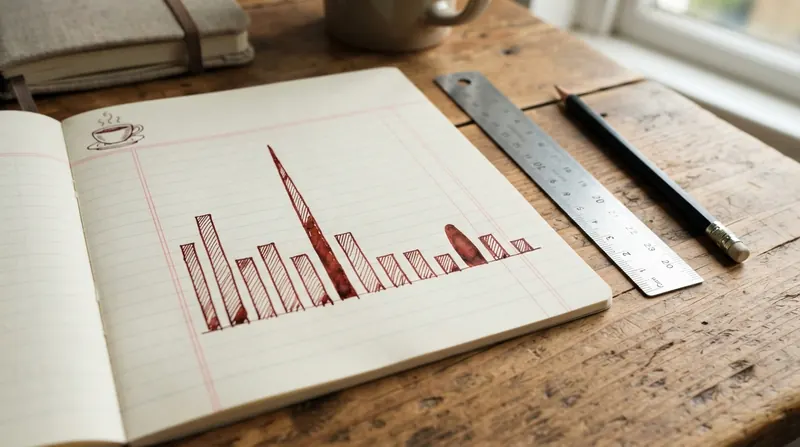
If you draw the debits as bars, which I did one night with a fountain pen, you get a shape that drifts down with a spike for the Fourth and a bump for the storm.
That shape is about my afternoons. It is not a chart of any reading, and I'd be ashamed to dress it up as one.
What the bars do show is that the hour moved. The kettle took the old cart's place at two-forty-five, and the walk took the bakery's place at suppertime.
Gus noticed before I did. In week seven he said, "You haven't come home with a white box in a month," which for a man who notices engines and not boxes was a remarkable audit.

The walks became the part of the ledger I looked forward to posting. Gus counted the royal palms on the way out and the boats on the way back, which is the most romantic thing he has done since 1982.
I'll tell you what I think happened, as a bookkeeper rather than a scientist. I gave the most expensive hour of my day a different line item, and the line items around it changed too.
What the Ledger Taught Me About the Hour
I've kept books long enough to know that totals lie less than people do, but they still don't tell the whole story. So here's the part of the summer the weekly totals can't show.
The hardest minute of the day was never three o'clock itself. It was two-forty, when the house got quiet and the light came off the water and my feet started walking toward the car keys on their own.
The kettle worked because it gave that minute a job. Filling it, waiting for the click, choosing one bag or two and setting the timer is four small tasks, and four small tasks are enough to carry a person past two-forty.
By the time the timer rang, the walk to the bakery felt like a long way to go for something I could post in the ledger instead. Some days I went anyway, and I posted it, and the ledger held it without comment.
Inez had been right about the hands. The tea gave three o'clock something to do with its hands, and that turned out to be most of what three o'clock wanted.
The walks were a different kind of credit. They weren't a replacement for anything; they were a reason to leave the house at suppertime with a man I like.
Gus started out walking because I asked him to keep me company. By August he was setting his watch for it and complaining if a rain shower cost us a lap.
I don't know which of the three, the cup, the walk or the pencil, did the most. If I had to bet, as a bookkeeper, I'd bet on the pencil, because the pencil is what made me look.
Walt, how did you rule a ledger with three kinds of credit: cups, walks and glasses of water?
4:15Three sub-columns, one total. Never mix the categories, Adele; you taught half the staff that.
4:31Fair. And the Fourth of July, seven debits in one day?
4:33Post it and close the day; a holiday is a line item, not an error. Send me a photo of the page.
4:36Back at the Clinic With the Ledger
At twelve weeks I went back with the red ledger in my tote bag. My question list was paper-clipped to the cover, the way I used to clip a variance report to a statement.
My clinician read the ledger, which I hadn't expected. She turned the pages slowly, the way you read a ledger when you respect the person who kept it.
Then she turned the screen toward me again. The word she used was "steadier," and she said the direction from June had flattened out.
I asked her what had done it, because that's what a bookkeeper always asks: which entry moved the total?
She said the walks, mostly, and the smaller afternoons, and the fact that I'd kept writing it down. She said she couldn't tell me what the tea did on its own, and that I shouldn't let anybody else tell me either.
That's the most useful sentence in this whole column, so I'll post it again in plain words. Nobody can separate the cup from the walks from the ledger, and the person who reads your labs is the one who decides what it all means.
There's one more entry I want to post from that visit, because I think it's the one most columns would leave out.
On the way out, I asked the woman at the front desk whether other patients ever brought in ledgers. She laughed and said mostly they brought in phones full of numbers, and that the phones never had the afternoons in them.
That's the gap a pencil fills. A phone remembers what a meter said, and a ledger remembers what you did at two-forty, which is the part you can actually change.
I don't say that to sell anybody a ledger, either. A spiral notebook from the corner store works, and so does the back of an envelope taped inside a cupboard door.
She asked me to keep the ledger and bring it in December. She also asked me to keep saying "gymnema" out loud at every visit, and to call if I added anything else to the cupboard.
I drove home along the lake with the radio on this time. I stopped at the bakery, too, and bought one slice of key lime pie, and posted it in the debit column in ink with the date.
A ledger isn't a diet. It’s a record of how your own afternoons really go, kept gently and permanently, so you can decide what to do with them.
The comments above are illustrative composites edited for length, in keeping with the dramatization noted at the top of this column. They're not customer reviews, and nobody here was paid or given anything to write them.

The Sugar Ledger · Lanai Tapes, Episode 3
The Bookkeeper and the Pastry Chef, One Teapot Between Them
Adele
host
Inez, the readers want to know why a woman who made the club's coconut cake for twenty-six years walked up my steps with a bag of bitter tea.
 Inez
guest
Because I watched you sign for my pie every afternoon for twenty-six years, and I knew the pie wasn't the problem; three o'clock was the problem. You needed something to do with your hands at three o'clock.
Adele
host
And you picked the one plant that made your own buttercream taste like a beach.
Inez
guest
I picked a plant I trusted to be honest: one leaf on the label, a phone number on the back, and a company that tells people to ask their clinic first. I've worked for people who lied on the menu, and this bag doesn't.
Adele
host
I audited it, you know: the library, the label, the phone call. The research is real, but it's small studies, and none of them tested a tea bag on a lanai.
Inez
guest
I never told you it was a study; I told you it was a kettle. You're the one who went looking for footnotes, and I love you for it, but the kettle did its job before the footnotes arrived.
Adele
host
So what would you tell somebody reading this who has a three o'clock of their own?
Inez
guest
Call your clinic first, then put the kettle on at a quarter to three, and walk after supper with somebody you like. And keep one slice of pie a week in the ledger on purpose, because a life without pie is a ledger nobody keeps.
Before Any Order: The Numbers on One Line
If you've read this far, you're the kind of reader who wants the numbers before the button. Here they are, the way I'd post them on the last line of a page before carrying them forward.
One bag of 30 · ask your clinic first · read the return terms below
The Return Terms, Read Like a Contract
I read return policies the way other people read mystery novels, from the last page first. Here's this one, without any polish.
The seller's policy runs 30 days from purchase. To be eligible, an item must be unused, in the same condition you received it and in its original packaging.
Then comes the clause that matters most for a tea. The seller counts its herbal teas as perishable food, so once a bag is opened it can't be returned, unless it arrived damaged or defective.
Sale items aren't refundable, and you pay your own shipping on a return. Approved refunds go back to your original payment method within 7 to 10 business days, according to the policy.
I'd like to be plain about what that means: this is not a money-back promise on an opened bag, and I won't call it one. If you open it and don't like the taste, that's a $14.95 lesson, not a refund.
Is that unfair? I don't think so.
A bakery doesn't take back a slice of pie you've eaten half of, and a tea company that calls its bags food is being consistent.
But it does change how I'd buy. One bag first, not three, and taste a cup before you decide whether the second bag belongs in your ledger at all.
Here are the other terms I could verify, posted in a row so you can check them yourself.
Shipping: standard shipping by UPS or USPS at no charge, estimated 2 to 5 business days; orders are processed in 2 to 3 business days from the Port Orange facility. Faster shipping is offered at checkout for a price.
Where it ships: addresses in the US, US territories and APO/FPO/DPO addresses, according to the shipping policy.
Damaged in transit: the policy asks you to contact the carrier and keep the packaging. If you need an exchange for a damaged bag, the policy gives an email and the Port Orange address.
Contact: phone (386) 274-8520, email [email protected], and 1955 Taylor Rd, Port Orange, FL 32128, all printed on the seller's contact page.
The seals on the bag: "Caffeine-Free," "No Preservatives," "No Artificial Flavors," "No Fillers" and "Manufactured in the USA from Globally Sourced Ingredients." Those are the seller's own statements, and I'm quoting them, not certifying them.
One more thing I noticed on the store's banner, and I'll tell you because I'd want to be told. The top of the site runs a line about limited offers and a final batch.
I don't put much stock in banners like that, and you shouldn't either. Thirty-one years of vendor mail taught me that "last" is a word that comes back every season, like hurricane shutters.
Read the return policy before the label, and the label before the banner.
Who the Cup Fits, and Who It Doesn't
After a summer of posting, here's my honest sorting, the way I'd sort chits into two baskets on a busy afternoon.
- You have an afternoon hour that keeps its own account: a bakery, a cookie bowl, a vending machine you'd like to give a different line item
- You like a ritual with your hands busy for eight minutes, not something to swallow with water
- You don't mind a mild, green, slightly bitter cup, or you'll drink it iced with lemon
- You want one plant on the label, a phone that answers and a street address you can drive to
- You'll keep a ledger of some kind and bring it, along with the bag, to your next appointment
- You want a promise about your numbers; nobody honest can give you one, and the FDA line on the back says the claims haven't been evaluated
- You take something for your numbers and haven't asked your clinic yet; ask first, as the seller's own caution says
- You're pregnant or nursing; the label asks you to talk to a healthcare provider first
- You only like sweet, flowery teas, and honey would end up doing all the work
- You want to be able to return an opened bag; the policy doesn't allow it
If you landed in the second basket, that's not a failure. It's a ledger entry, and a good bookkeeper posts those too.
Fifty Cents a Cup, Carried Forward
Let's do the arithmetic the way I did it at my counter, because the price is the one claim on this page that's pure math.
The bag is $14.95 for 30 tea bags, which is just under fifty cents a cup at one bag per cup. If you brew two bags for a strong cup, as I did on pie days, it's about a dollar.
I'm not going to pretend a tea bag is a slice of key lime pie. They're different pleasures, and I still post a slice on purpose most Sundays.
But in bookkeeping terms, the cup moved one line item from six-fifty to fifty cents, four afternoons a week, for about twelve weeks. The ledger says that came to roughly three hundred dollars, which Gus has already spent in his head on a carburetor.

Short answers to the questions the canasta table asked
What exactly is in the bag?
One ingredient: "Gymnema Leaf, cut & sifted (Gymnema sylvestre)." Thirty tea bags, 1.59 oz (45 g) in all, which works out to about one and a half grams of leaf per bag by my own division.
How do you make it?
The label says to pour 8 oz of fresh, boiled water over a bag and steep 5 to 15 minutes, using two bags for a stronger cup. I steep one bag for eight minutes most days.
What does it taste like?
The seller calls it "mild, slightly bitter" with "earthy, herbaceous notes and a hint of sweetness." My husband calls it "the lawn," and it's better iced with lemon on a hot day.
Does it have caffeine?
The bag says caffeine-free, which is why I drink it at the old three o'clock hour without paying for it at midnight.
Will it change my numbers?
Nobody honest can promise that, because the research on gymnema pooled small studies of supplements, not this tea bag, and the FDA line on the back says the claims haven't been evaluated. My clinician credited my walks and smaller afternoons, and couldn't say what the cup did alone.
I already take something for my numbers. Can I drink it?
Ask your clinic before the first cup and bring the bag with you. The seller's own product page says people in exactly that situation should consult a healthcare professional before using gymnema.
Is it organic?
The bag doesn't say so, and the woman who answered the phone wouldn't claim it either. I'm not going to claim it for them.
Does the leaf really make sweets taste flat?
The old tradition says chewing the leaf dulls the taste of sweetness for a while; in a strong cup I sometimes noticed a little of it, and in a weak cup I didn't notice anything. Count that as my tongue, not as evidence.
Can I return it if I don't like it?
Only if it's unopened, within 30 days, in its original packaging, because the seller counts opened tea as perishable food and won't take it back unless it arrived damaged. That's why I'd buy one bag first.
How do I reach the company?
Palm Beach Herbal Tea Company, 1955 Taylor Rd, Port Orange, FL 32128. Phone (386) 274-8520; email [email protected].
The Last Line on the Page
In my old office, the last line on a ledger page was where you carried the balance forward. You wrote it in ink, double-underlined it and turned the page.
Here's my balance, carried forward from a summer on the lanai. One leaf, one kettle, one walk, one ledger and one clinic, in the order of size, smallest first.
One bag of 30 tea bags · start with one and taste a cup first
P.S. The red ledger is on my kitchen counter now, next to the kettle, with the steel ruler inside it as a bookmark; if you have an Inez in your life, thank her; if you are the Inez, carry the bag up the steps anyway.
P.P.S. Remember the order of size: the cup is the smallest line on the page, the walks are bigger, and the clinic is the biggest of all, yet the cup is the only one that comes in a bag.
The full ingredient and advertising guide, with the seller's caution printed word for word, a note on the one leaf in the bag and an honest look at the headlines around it, is linked at the foot of this page.